Why Georgia? The Geography Behind Faster FBA Inbound
Georgia is only far away if you measure from your dock. Measure from where Amazon needs your inventory, and it is close to almost everything that matters.
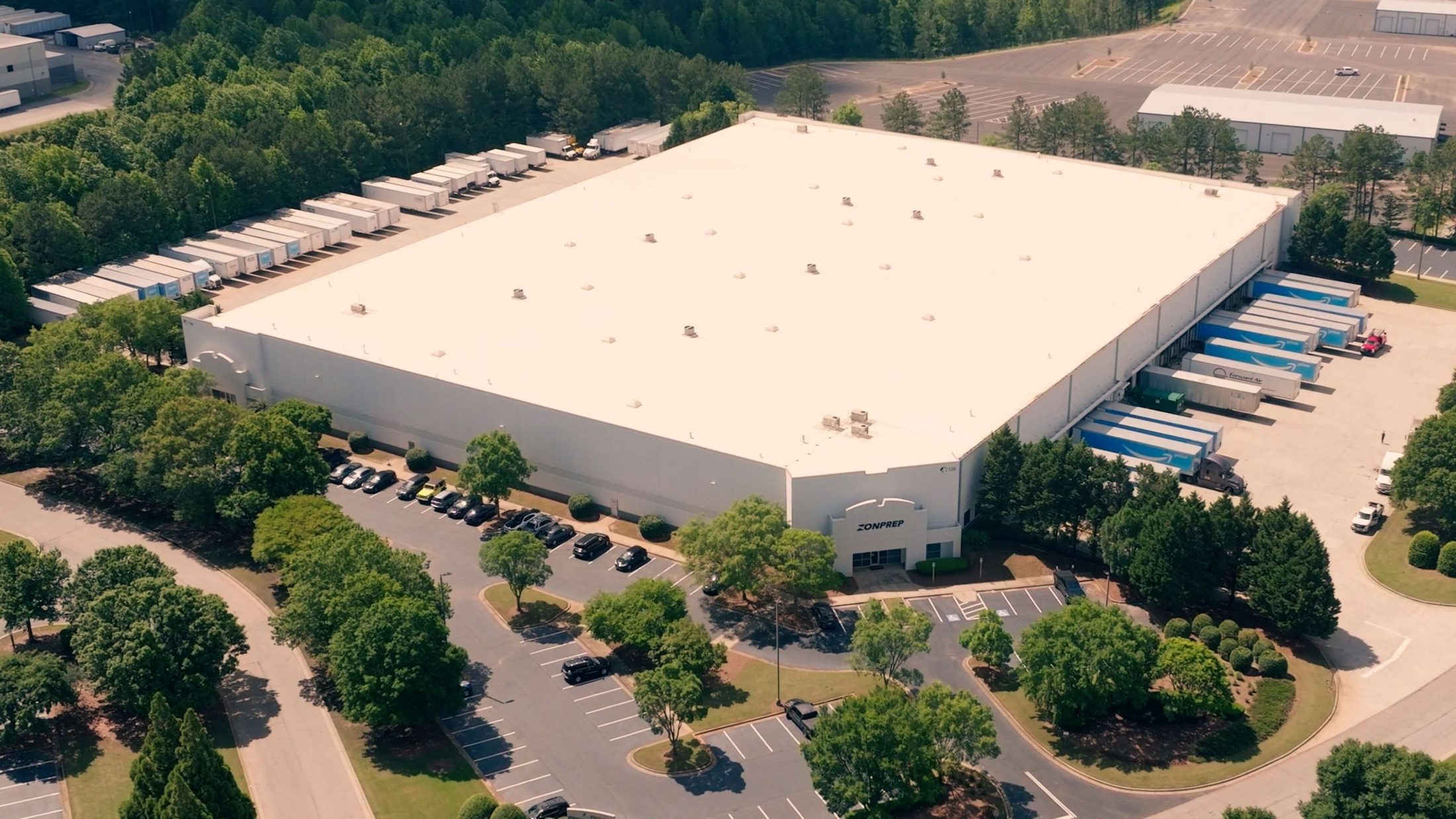
“You’re in Georgia. That’s so far away.”
If you run a brand out of California, or your containers land at Long Beach, it’s a fair first reaction. Your product is on one coast. Your prep partner is on the other. Every instinct says that’s backwards.
Lou Casados, our head of sales, hears it all the time. His answer: it’s only far away if you measure from your dock. Measure from where Amazon actually needs your inventory, and Georgia is close to almost everything that matters.
This piece walks through that geography with real numbers. We pulled them from our own database of Amazon facilities, the same data behind our Amazon Fulfillment Center Locator.
The wrong distance to optimize
Most brands choose a prep or logistics partner the way they’d choose a warehouse: close to where the product starts. Close to the port. Close to the factory. Close to the office.
That minimizes one leg: origin to prep.
But that isn’t the leg that decides when your product becomes sellable. The leg that decides it is prep to Amazon, and specifically to the Amazon facilities your shipment plan sends it to. That leg runs on Amazon’s network, Amazon’s appointments, and Amazon’s geography. If your prep partner is far from the bulk of that network, every shipment pays for it on the way in.
So the right question isn’t “how far is Georgia from me?” It’s “how far is my prep partner from where Amazon receives, sorts, and stores my inventory?”
Where Amazon’s network actually sits
Our Amazon facility database holds 3,101 facility records across 24 countries, including 1,885 in the United States. We filtered it to active US facilities and split the country in two:
- West: the 13 Pacific and Mountain states (WA, OR, CA, NV, AZ, UT, ID, MT, WY, CO, NM, AK, HI).
- East and central: everywhere else.
Here’s what that shows:
| Active US Amazon facility type | Total | East and central | Share |
|---|---|---|---|
| Sort centers | 126 | 94 | 75% |
| Fulfillment centers (sortable, non-sortable, robotic, small-and-light and oversize) | 415 | 307 | 74% |
| Inbound cross-docks (IXD) | 71 | 41 | 58% |
Roughly three of every four active Amazon sort centers and fulfillment centers in the US sit east of the Rockies. That’s where your inventory is stored, picked, and sent to customers.
The inbound cross-dock count is closer to even, and California alone accounts for 19 of the 71. That matters, and we’ll come back to it. But inbound cross-docks are a stop on the way. Fulfillment centers are where inventory becomes Prime eligible and starts selling.
Two caveats so you can read this honestly. First, these are building counts, not square footage or throughput. A single large West Coast FC can do the work of several smaller ones. Second, Amazon’s network changes constantly. This is a snapshot of our database, and you can check any facility yourself in the locator.
What that means for an inbound lane
Our facilities are in McDonough, Georgia, in the Atlanta metro. That location sits within one-day ground of roughly 80% of the US population.
Amazon builds its network around where customers are. Most US customers are in the East and central states, so most of the network is too. A Georgia hub puts your inventory one day of trucking from most of it.
That’s the operating model:
- 50 to 70 inbound trucks a day arrive at our facilities.
- That freight is prepped, labeled, and consolidated into 30+ floor-loaded truckloads leaving for Amazon’s regional cross-docks, Monday to Friday.
- Live unload appointments are booked 21 days in advance through Amazon Carrier Central, where ZonPrep is listed as a carrier. You don’t book a thing.
- Average check-in at Amazon is 24 to 48 hours, measured from when shipments leave our facility.
Short lanes, full trucks, booked appointments. That combination is what turns a location into a speed advantage. Location alone doesn’t do it. Location plus density does.
Density is the part that’s hard to copy. A truck to an Amazon regional facility only runs full and on schedule if enough freight is heading to that same destination every day. At our volume it is. A smaller operation in a better-looking spot on the map can still end up holding freight for days to fill a truck, or sending it as LTL.
The placement fee connection
Geography also decides what you pay to get into Amazon.
When you create a shipment in Seller Central, you choose between sending everything to a single destination and paying Amazon’s inbound placement fee, or splitting the shipment across Amazon’s regional facilities and paying zero placement fee. Amazon’s own preference is clear: regional, optimized splits distribute inventory closer to demand.
The catch is that optimized splits mean more destinations. Hitting several regional facilities efficiently is much easier from a hub that’s already close to most of them. A Georgia hub can run optimized splits as full truckloads on short lanes. A hub on the edge of the network has to send long, expensive lanes to most destinations, which is why so many sellers default to paying the fee.
Our clients send optimized shipments, not placement-fee shipments. In 2025 that saved them more than $45 million in inbound placement fees, in aggregate.
What happens to a single-destination shipment
It’s worth spelling out what the placement fee actually buys, because geography is the whole story.
A single-destination shipment lands at one of Amazon’s national inbound cross-docks. Amazon then re-sorts it and splits it out to regional inbound cross-docks, and from there to fulfillment centers. Your units can become technically sellable once they’re checked in at that first national stop. But they don’t become Prime eligible until they reach a fulfillment center close to the customer.
Lou’s breakdown of that journey, from the seller’s warehouse:
- To the national IXD: 10+ days
- To the regional IXD: 30+ days
- To the fulfillment center: 43+ days
- Plus inbound check-in time on top
In other words, when you pay the placement fee, Amazon does the geographic distribution for you, and it takes weeks. Even in the best case, Amazon’s fastest time to Prime eligibility when paying placement fees and sending to a single location is about 26 days, plus check-in.
Sending optimized splits directly to regional facilities cuts out that first national stop. The inventory starts its life in Amazon’s network already close to where it will sell. That’s the job a well-placed hub does: it lets you do the distribution up front, on full trucks and short lanes, instead of paying Amazon to do it more slowly.
One note on what we control. ZonPrep doesn’t directly set Prime eligibility. Amazon controls how fast inventory moves inside its network. What you control is the inbound choice: placement fees to one destination, or optimized splits to the regional facilities. Geography decides how cheap and fast the second option is.
It’s also worth knowing that Georgia itself hosts 4 of the 71 active US inbound cross-docks in our database. Some of your inventory’s first stop is just down the road.
“But my product lands on the West Coast”
This is the real version of the objection, and it deserves a straight answer.
If your containers land at Los Angeles or Long Beach, moving freight across the country to Georgia is a cost. We’d never pretend it isn’t. Here’s how to weigh it:
- Compare the full journey, not the first leg. The cost that matters is port to sellable at Amazon. A short trip to a nearby prep warehouse can be followed by a long, slow inbound into Amazon, a placement fee, and weeks of FC transfers before your inventory is Prime eligible. Add every leg up.
- Look at where your units actually sell. If most of your demand is in the East and central states, and for most US brands it is, then most of your inventory has to cross the country eventually anyway. The only question is whether it crosses as consolidated freight you control or as fragmented FC transfers inside Amazon’s network that you don’t.
- Price the lane, not the mile. A locked weekly truckload lane at a flat per-pallet rate can cost less per unit than a short run of scattered LTL. Distance is one input. Consolidation is a bigger one.
- Use the West where it makes sense. Optimized splits still send part of your inventory to West Coast regional facilities. Being in Georgia doesn’t mean ignoring the West. It means serving it as one destination among several, not all of them.
The way to settle it is to run your own numbers. Our complimentary FBA Opportunity Analysis puts your current inbound side by side with the same volumes running through ZonPrep, freight included.
One address, no matter how you split
Both of our facilities are in McDonough, close together on purpose. One handles FBA prep. The other, the ZonPrep Consolidation Center, takes cross-dock volume. Lou put the reason plainly when we opened it: “The motivation for having it so close was so we can maintain our aggressive freight costs and lightning-fast inbound times with little impact to our clients using our Cross-Dock solution.”
For you, nothing changes. You still ship to one place. We handle the splits.
How to check your own geography
Before you decide where your inventory should be prepped, spend an hour on this:
- Pull your last 90 days of FBA shipment plans. List every Amazon destination they were assigned to.
- Look each one up in our Fulfillment Center Locator. Note the state and the facility type.
- Count how many are east of the Rockies. For most US brands, it’s the majority.
- Measure your lane from prep to those destinations, in days, not miles. Then add check-in time.
- Compare that to a hub one day of trucking from most of them.
You’ll know very quickly whether your current location is helping your inbound or working against it.
The bottom line
“Georgia is far away” is true if you only measure the first leg. Measure the whole journey into Amazon and it flips. About three quarters of Amazon’s US sort centers and fulfillment centers sit east of the Rockies, and McDonough is one day of trucking from most of them.
We didn’t end up in Georgia by accident. It’s where an Amazon-focused supply chain belongs.
If you want to see your own lanes mapped against ours, request a complimentary FBA Opportunity Analysis.
Let’s get after it.
Related reading: