Pricing Your Amazon Supply Chain Partner: Why The Cheapest 3PL Will Cost the Most
The lowest prep rate rarely means the lowest cost. How to find your true per-pallet rate, the red flags in a cheap quote, and how to price a partner.
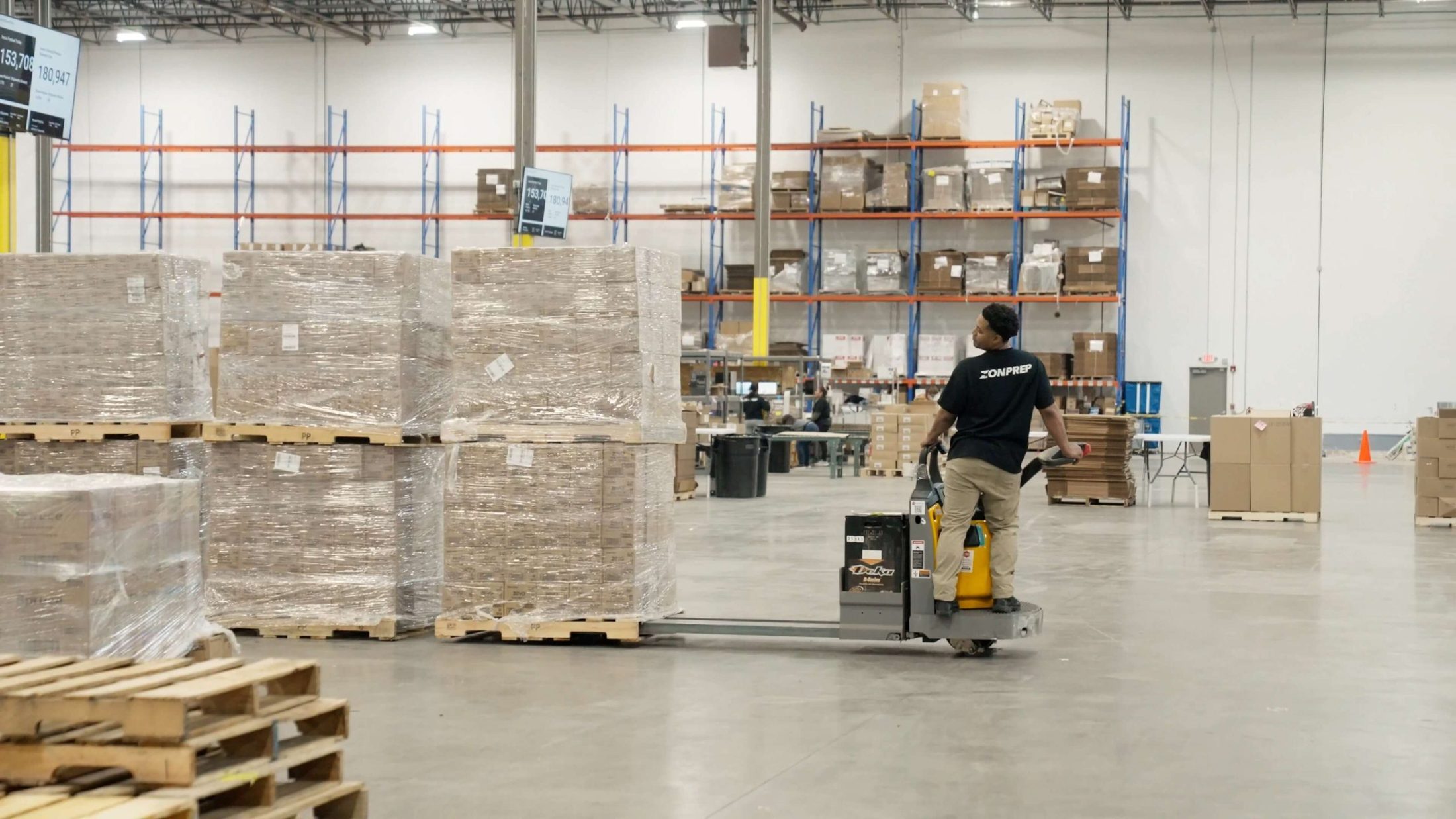
Pick two: Good, fast, or cheap.
The quality triangle spans across industries, and eCommerce logistics is no different. We see brands move from 3PL to 3PL chasing better rates, saving a few cents on paper, and then suffering from inconsistent service and mistakes.
For the Amazon supply chain and logistics space in particular, we recommend always picking good and fast. Having the lowest-cost 3PL will kill your supply chain.
Let’s go over why.
Stop looking at your per-unit rate
Instead of a straight per-unit rate (label, poly bag, bundle, etc) you should look at a holistic picture including placement fees and freight.
Use this formula to find your true per-pallet rate:
(Placement fees + freight + prep) ÷ pallets shipped
If you ignore freight, you risk getting the cheapest prep partner that costs you much more in freight and inefficiency. Imagine a partner that saves you two cents a unit on labeling but sends your freight as scattered LTL to a single destination, so you need to pay Amazon’s inbound placement fee.
3 Risks of the cheap option
When a provider wins on price, the margin has to come from somewhere. Usually it comes from response times, optimization, or consistency.
Response time
If you’re paying someone 10 cents a label, you’re probably not getting a response on a client issue for a couple of days, if not longer.
At rock-bottom rates there’s no margin left to pay for account managers with the time and authority to fix your problem quickly. So a stuck shipment, a wrong label, or a missed pickup sits in a queue. Meanwhile your inventory isn’t moving and your days of cover are going by.
Optimization
Cheap providers are order-takers. They prep what you send and ship it exactly how you tell them, without double checking whether there’s a better way. Nobody is looking at whether your shipments should be optimized splits instead of placement-fee shipments, whether your freight should consolidate into full truckloads, or whether one odd carton is knocking a whole shipment out of the zero-placement-fee option.
For proper optimization, you need to work with a provider who understands Amazon’s inbound network and FBA rules.
Consistency
Your lead time is only useful if it’s predictable. A provider running near capacity can hit SLAs in March and miss them by a week in November. Every miss forces you to hold more safety stock, which pushes up your storage cost and ties up more cash. You pay for inconsistency with more wasted inventory.
Switching comes with costs, too
Switching providers will always come with some costs in time and money, so keep in mind you’ll need to account for the following with every switch.
- New onboarding. Your team re-trains your prep requirements, SKU quirks, and compliance rules from scratch.
- A learning curve on your catalog. Errors cluster in the first few weeks, usually when you’re least able to absorb them.
- Lost history. Your previous partner knew which SKUs needed suffocation warnings, which cartons ran heavy, which shipments to watch, and other knowledge that doesn’t transfer easily.
- No compounding. The longer a good partner runs your freight, the better they get at it: tighter lanes, smarter splits, fewer surprises. Hopping resets that to zero every time.
The brand that moves every 12 months for a better rate never gets the benefit of a partner that knows its business. It’s often churn, more than one bad provider, that results in terrible inconsistency and lack of optimization.
Red flags in a cheap quote
A low quote isn’t automatically a bad partner. But certain gaps tell you where the low price is coming from. Watch for these:
They quoted before seeing your data. A partner who can price you without looking at your shipment history, your SKU mix, or your current placement-fee spend is pricing a generic customer. They don’t know where your costs actually are, so they can’t tell you how to lower them.
There’s no prep SLA in writing. “We usually turn things around in a couple of days” is not an SLA. Ask for the maximum, whether it’s contracted, and what happens during peak.
Nobody asks about your shipment splits. If the conversation never gets to whether you’re paying placement fees, the partner isn’t planning to change it. A partner who builds shipments for Amazon all day catches that before it costs you, but a label-and-ship operation doesn’t even check.
A specific example: Amazon generally requires at least 5 identical cartons per item, with matching quantities and item mixes, to open up its split options. One odd carton, say 20 cartons of 24 units plus one of 12, can push a whole shipment plan out of the zero-placement-fee option.
There’s no proof-of-delivery process. When Amazon receives fewer units than you shipped, the claim depends on a signed POD and a deadline. But who collects the POD, files the claim, and monitors your windows? Unless your partner handles all of this, you could be getting back more admin work than you expect.
They can’t tell you their check-in times. A 3PL shipping into Amazon at high volumes will know their average check-in times. They’ll be able to show how long it takes from leaving the dock to check-in at Amazon. If you don’t measure this, you can’t monitor and improve it (and plan for it).
A long rate card and short descriptions. If you see plenty of line items capturing every single move (so they can charge for it) with little detail means you’re just paying for labor. You aren’t really getting a partner.
Keep an eye out for these red flags, or you may find yourself paying for them later.
The benefits of a premium logistics partner
ZonPrep won’t be the cheapest option, and we don’t try to be. We price as a premium partner, and we think the right way to evaluate that premium is to ask what we remove from your plate.
| Capability | Your Responsibility | With ZonPrep |
|---|---|---|
| Freight | Floor-loaded truckloads with live unload appointments | Truckloads with priority live unload appointments |
| Prep SLAs | You define, staff, and enforce them | Contracted and measured |
| Visibility | Shipment tracking tools | One portal |
| Proof of delivery | POD access and claims you own | PODs accessed and claims handled for you |
| Scheduling | Freight scheduling and carrier relationships | Scheduled against your cadence |
| Systems | An Amazon-specific WMS built for shipment splits and FBA prep | Included |
And a few of our operating numbers to back all of it up:
- The capacity to move 1 million units a day.
- 20 million+ units into Amazon every month, for 200+ brands.
- 99.9% FBA-compliant accuracy across more than 100 million units shipped.
- 72-hour maximum prep SLA, 365 days a year.
- 24 to 48 hour average check-in at Amazon, measured from when shipments leave our facility.
- More than $45 million in inbound placement fees saved for our clients in 2025, in aggregate.
All of the above means that you can grow, run promotions, go big in peak, throw an awkward kitting project at us, and we can tackle it all without breaking a sweat. Instead of planning growth around whether your 3PL can handle it, you can reach for the stars.
Unlocking your ability to focus on mission-critical items
When you have a logistics partner that owns the whole FBA inbound supply chain, from pickup to prep to freight to check-in at Amazon, your team only has to be good at three things:
- Forecasting
- Demand planning
- Allocation
In other words: deciding what to make, how much, and when to get it to us. Everything after that is our job.
Those three are where an Amazon brand actually wins or loses. A better forecast protects your rank and your cash at the same time. Better allocation gets inventory to the right place before the demand shows up. No logistics vendor can do that work for you, which is exactly why your team’s hours should go there and not into chasing a label vendor.
That’s a very different operating model from managing a cheap provider. With a cheap provider, your ops team becomes the quality control layer: checking labels, chasing pickups, re-routing shipments, filing claims. You’re paying for the work twice, once in the rate and once in your own headcount.
The goal is to let your team do what they do best and execute on the stuff that matters.
How to price a partner
Before your next RFP, change what you’re comparing:
- Calculate your true per-pallet rate today. Placement fees plus freight plus prep, divided by pallets shipped. Pull 6 months of data, not one good week.
- Measure your current lead time and its spread. Shipment creation to check-in, for every shipment in the last 90 days. The slow tail is what sets your safety stock.
- Put a dollar value on your team’s time. How many hours a week does your ops team spend chasing your current provider? That cost belongs in the comparison.
- Ask every bidder the same three questions. What’s your maximum prep SLA, and is it contracted? What share of shipments do you send as optimized splits versus paying placement fees? Who answers when something breaks on a Friday afternoon, and how fast?
- Compare total landed cost and total time to sellable. Not the label rate.
The bottom line
Good, fast, cheap. You need to pick two, and there’s a right answer when you sell on Amazon.
The brands that scale on Amazon pick good and fast, then make the economics work by eliminating the costs a cheap provider leaves on the table: placement fees, bloated safety stock, and the hours their own team spends cleaning up.
If you want to see your true per-pallet rate next to what it would be with ZonPrep, request a complimentary FBA Opportunity Analysis. There are no contracts or prepayments, and your first shipment is a trial. We earn the relationship.
Let’s get after it.
Related reading: