Four Tips to Get Inventory into Amazon Faster in Q4
Your freight left on time, but your units are not sellable for weeks. Four levers that still speed up Amazon inbound in Q4: arrival day, the five-box rule, consolidation and rhythm.
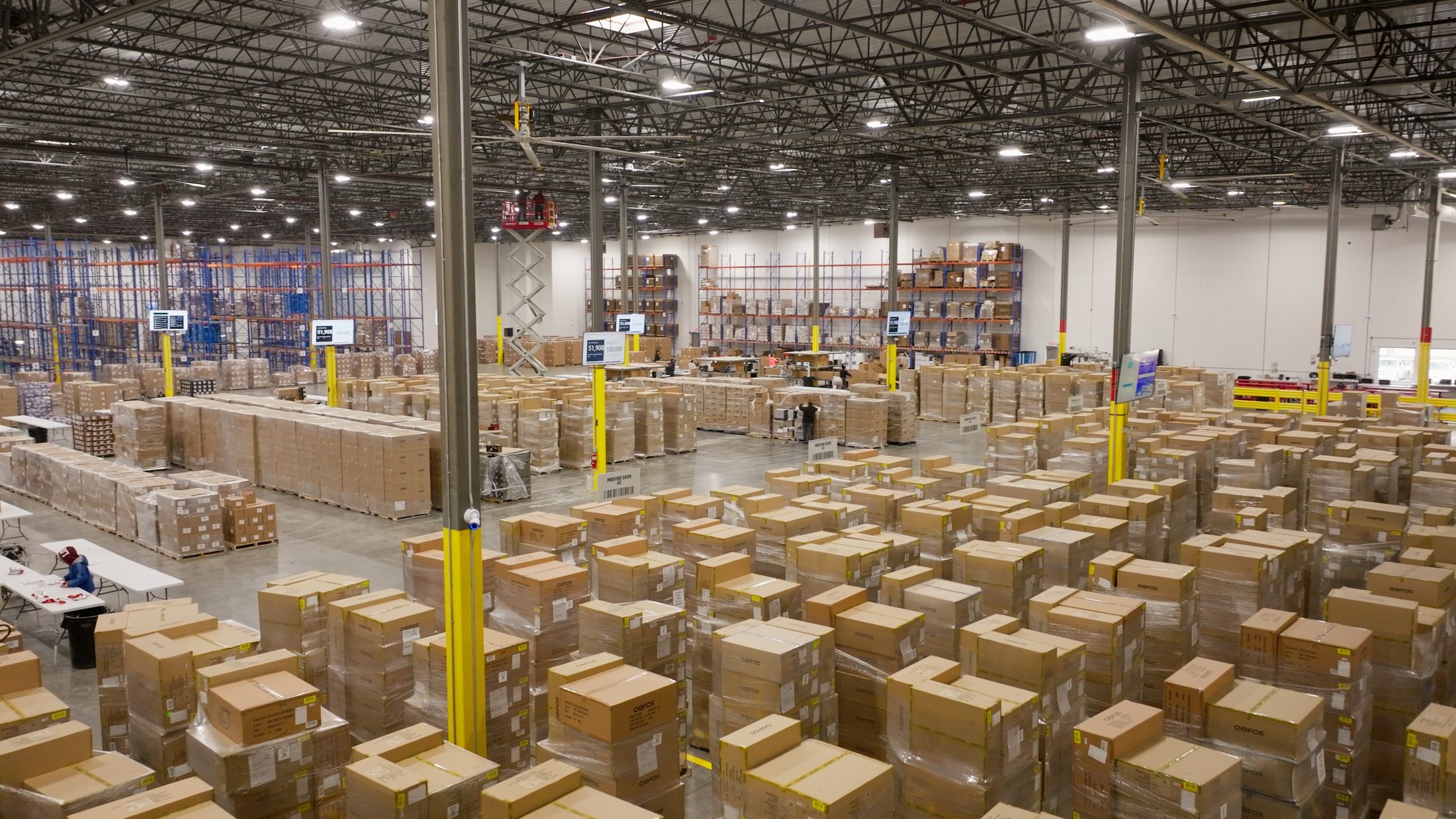
Your prep partner can turn around a shipment in two days. Your freight can leave on time. Your Seller Central dashboard says shipped. But your units may still not be sellable for another three weeks.
Why does this happen? It’s a result of lacking inbound planning, rather than prep or just bad luck.
Sellers shipping direct into Amazon’s network wait 10 or more days to reach a national inbound cross-dock, 30 or more to reach a regional one, and 43 or more to land at a fulfillment center. Inbound check-in sits on top of that, and Prime eligibility does not start until the unit reaches the fulfillment center.
Many operators track days from PO to carrier pickup, but that’s only the short half of the journey. It’s mid-September. You have somewhere between four and six weeks before the decisions you make stop affecting Q4 and start affecting Q1.
Here is what still moves the needle in that window, in the order we would do it.
Know your ship-date-to-sellable days
Most operations teams have a clean number for dock-to-truck, but very few know their number for ship-date-to-sellable, which is the timeline your storefront relies on.
A unit that has been received at a national inbound cross-dock is technically in Amazon’s system, but it isn’t Prime-eligible. It sits in transfer between facilities, while your listing fights to compete without it.
When you ship to one location within the Amazon network, you see placement fees as the cost on an invoice. But there is also a time and opportunity cost that comes from those extra days in transit.
Your inventory runs like this: Shipment leaves → Units are checked in, which reads as sellable but is not really → Fulfillment-center transfer days start ticking → Prime eligibility is delayed → Your replenishment cadence slips, because the reorder point assumed inventory that is not live yet → You’re out of stock during the key eCommerce quarter
The Amazon distribution network is sophisticated and well optimized for fast deliveries, and during the busiest time of the year it’s no surprise that they aim to incentivize sellers to send inventory directly to the best warehouse location for each SKU’s demand.
Now, what can you actually control? There are four key levers we urge you to focus on.
Four levers to speed up your inbound receiving times
Lever one: Arrival day
Arrival day at your prep facility dictates which week your inventory reaches Amazon. A Monday arrival can get processed, shipped, and inbounded to the network inside the same week. A Wednesday-or-later arrival rolls to the following week.
During peak, those few days mean the difference between covering a sales spike and reading about it afterwards.
Work backwards: Last safe ship date = peak date − receipt time − transit
- Peak date: When you need your inventory during peak
- Receipt time: How long it will take for your inventory to be received and available for sale on Amazon
- Transit: How long does freight and delivery take, including any FBA prep needed
Check that calculation for BFCM and again for your pre-holiday replenishment. If you’ve found that the date has already passed, at least you’ve learned something important about next year.
Reminder: Use your prep partner’s committed receipt-to-ship time, not their average on a quiet Tuesday in June. Those numbers diverge during peak season, so it’s important to have their updated commitment timelines.
Lever two: The five-box rule
At five or more boxes per SKU, you unlock Amazon’s split options. Below that threshold, you are largely choosing between paying the inbound placement fee or not shipping. At or above it, you can send an optimized split across regions.
If you send everything to one destination and pay the placement fee, Amazon redistributes your inventory for you. That takes 43-plus days, and the fee scales with every unit you send.
If you split the shipment across regions instead, your freight lands closer to demand on day one, so check-in and time to sellable is faster.
Both options are acceptable depending on what you’re trying to achieve, but we recommend at least for Q4 taking the fastest, most efficient inventory route.
The practical move to do this is pull your SKU list this afternoon and sort by units per inbound shipment. Every SKU sitting at three or four boxes is a candidate for a purchasing change, not a shipping change. Some of those will be worth buying deeper to clear the threshold.
Amazon’s pack later option lets you decide where everything is going before you pack it, rather than trying to build five identical boxes up front. For a wide catalog with uneven velocity, your mileage may vary.
Lever three: Consolidation and lane lock
Consolidate, then lock the lane. Scattered less-than-truckload shipments are slow for a reason that has nothing to do with your carrier’s performance. Every additional stop, transfer, and handoff is a queue your freight waits in. In Q4 every one of those queues is longer.
A floor-loaded full truckload with a live unload appointment does not wait in those queues. It arrives at a time Amazon has already agreed to.
Consolidation is also what makes the five-box rule affordable. Splitting across regions only pencils if somebody is aggregating enough volume to fill trucks. If you are filling five optimized trucks out of your own building, you are holding 150 pallets on your floor, and most operations do not have that space. Aggregate first, split downstream.
Then lock the lane. One origin, one destination, every week. Benchmark the rate quarterly rather than locking a long contract, because spot quoting 24 to 36 hours out generally beats a rate you negotiated in a different market. A locked lane is not about the rate. It is about removing the weekly scramble of finding a carrier during the busiest freight season of the year.
Lever four: Rhythm
You hopefully had a rhythm down back in August. Your volume changes with the season. The rhythm does not.
A weekly replenishment cadence held year-round is what makes every other lever work. It is what makes lanes priceable, trucks fillable, and forecasts survivable. Teams that ship in irregular bursts cannot lock a lane, cannot reliably hit five boxes per SKU, and cannot work backwards from a peak date because there is no repeatable cycle to work backwards through.
If you already have that cadence, Q4 is an exercise in holding it while volume triples.
If you do not, September is too late to build one and still see the full benefit this year. Say that plainly rather than pretending otherwise. What you can do in the next four weeks is run the last safe ship date calculation, fix your arrival days, and clear the five-box threshold on your top SKUs. Then build the cadence in January, when it costs you nothing to get wrong.
The sequence matters, and it matters in this order: get the rhythm right, then lock lanes, then consolidate, then time it, then get placement right, then protect it with documentation. Replenishment cadence is the prerequisite that makes lanes priceable and trucks fillable. Proof of delivery is the protective wrapper at the end, and in Q4 it earns its keep: collect the POD on every shipment, know your claim window, and assign an owner before peak rather than during it.
Q4 storage fees make slow inbounds expensive
One more reason the timing work pays for itself in this specific quarter.
Amazon’s monthly inventory storage rates step up for the October to December window, sometimes as much as 3x depending on category. Slow inbound forces you to carry more on-hand cover to protect against variance, and Q4 is exactly when carrying that cover gets expensive.
So the two halves compound. Slower transfer times force a bigger buffer. A bigger buffer costs more per cubic foot in Q4 than at any other point in the year. Speeding up inbound is not only a service-level improvement, it is what lets you hold less and still not stock out.
Check the current rates against Amazon’s published fee schedule before you build a number into a model. They change annually and they vary by category.
Ideal measurement state
We run opportunity analyses for sellers: their own inbound history, dock to receipt at Amazon, shipping direct, against what the same freight does routed through consolidation and optimized splits.
The gaps are not marginal. Across the analyses we published this month, an automotive parts seller went from 31 days to 7. A beauty brand went from 22 to 9. A food and beverage brand went from 15 to 4. Every figure carries the window it was measured over, and the accounts stay anonymous.
Those are selected results, not an average, and we say so on the page. Not every analysis finds nine days. Some find one.
You can see the current set at zonprep.com/about/results/.
For our part, the number that answers the Q4 question specifically is the one we quote year-round: five days or less from arrival at our facility to arrival at Amazon, and that holds through Prime Big Deal Days, Black Friday, Cyber Monday, and Q4 peak. Average inbound check-in at Amazon runs 24 to 48 hours from the moment shipments leave our facility, against an industry-standard check-in range of 7 to 43 days. We are listed as a carrier in Amazon Carrier Central, which is what makes live unload appointments bookable 21 days out instead of hoping for a door.
Time to Prime eligibility figures are based on actual shipment data from current ZonPrep clients, tracked and verified by our team. Individual results may vary based on product category, shipment volume, and Amazon receiving conditions.
What to do in the next two weeks
- Calculate your real ship-date-to-sellable time, not just dock-to-truck.
- Pull your last 30 days and measure from your ship date to the date units went Prime-eligible. Most teams have never seen this number and are surprised by it.
- Run the last safe ship date formula for Black Friday and for your final pre-Christmas replenishment.
- Put both dates on the operations calendar as hard stops.
- Fix arrival days. Move inbound freight to land Monday through Wednesday at your prep facility.
- Sort your SKU list by boxes per shipment. Everything at three or four boxes is a purchasing decision to make now, before the buy window closes.
- Assign a POD owner before peak, who knows how to measure the right number and work backwards from a date.
Q4 does not reward the fastest warehouse. It rewards the operation that knew its last safe ship date in September.