Amazon Growth Is a System: Why Optimizing One Dimension at a Time Doesn’t Work
Advertising, content, pricing, reviews and logistics are not independent levers. Here is how to trace an Amazon performance change back to the driver that actually caused it.

This is a guest post from Eyal Lanxner, Co-Founder and CTO of DeepM.
Amazon businesses naturally divide responsibilities across specialized functions. One person or team manages advertising, another works on content and SEO, while others oversee pricing, promotions, inventory, and logistics. The tools used to manage Amazon businesses tend to reinforce those divisions: advertising performance lives in one dashboard, search performance in another, inventory in another, and customer reviews somewhere else entirely.
Amazon performance, however, does not respect those organizational or technological boundaries. A shopper encounters one product and one offer. They see where the product appears in search, what the listing communicates, what it costs, how other customers rate it, whether it is available, and when Amazon says it will arrive. All of those factors can contribute to the same ultimate outcome: whether that shopper buys your product or a competing one.
The role of Amazon’s discovery algorithms, from traditional search to newer AI-driven shopping experiences, is in large part to predict and facilitate exactly that outcome: which products are most likely to satisfy a shopper’s intent. To do so, they need to consider multiple dimensions of marketplace performance rather than a single isolated signal.
As a result, a change in one area of an Amazon business can manifest somewhere that appears unrelated. A pricing change can affect conversion and eventually search performance. Better content can improve relevance for important searches. Changes in customer reviews can influence future shoppers and sales velocity. An inventory or fulfillment problem can affect the customer experience and conversion long before its impact becomes visible in a marketing dashboard.
Understanding what actually drives Amazon growth therefore requires looking beyond individual metrics and optimization functions. It requires looking at the marketplace as an interconnected system.
Amazon Performance Is a Chain of Cause and Effect
At a high level, the Amazon growth engine can be thought of as a progression from visibility to traffic, conversion, sales velocity, and ultimately marketplace performance. The apparent simplicity of that progression can be misleading, however, because every stage is influenced by multiple factors, and many of those factors influence more than one stage.
Search and discoverability determine whether a product appears for relevant customer searches and how competitively it is positioned. Content and relevance help Amazon and the shopper understand how well the product fits the search. Advertising creates additional visibility and traffic, while pricing and promotions affect how attractive the offer is relative to competing alternatives. Customer experience, including ratings, reviews and returns, shapes the confidence of future shoppers. Inventory, fulfillment and logistics determine whether the product is available, how quickly it can reach the customer and whether it arrives as expected. Together, these factors influence conversion and sales velocity, which themselves become important marketplace signals.
The mistake is to think of these as independent levers. Improving content does not matter only to a content metric, just as changing price does not matter only to margin. Advertising can generate sales that extend beyond the immediate value of the paid transaction, while an inventory decision can influence the delivery promise a shopper sees and therefore the probability of conversion. Each part of the system can create effects elsewhere, which means that evaluating any one of them in isolation provides only a partial picture.
A Performance Change Can Have Many Possible Drivers
Consider a relatively simple scenario: the organic position of a product for an important search term changes. Rank data can tell us that the change occurred, but it does not explain why. The underlying driver could potentially relate to pricing, content, advertising activity, sales velocity, customer experience, competitive changes, inventory availability, or some combination of these factors. Understanding the performance change therefore requires examining what was happening around it.
The examples below illustrate this with real-world products from the Home Improvement category, as captured by DeepM’s marketplace intelligence system. In each case, changes in search ranking were associated with a different potential driver, illustrating how the factor that matters most can vary across products and periods. To make these relationships comparable, all charts use relative rather than absolute measures: the product’s search rank position is measured relative to its close competitive set and compared with the product’s relative position on the relevant driver (price, review score, sales rank, or content relevance) against that same competitive context.
Pricing provides a useful example. A product moving from $29.99 to $27.99 is easy to identify as an isolated change, but the marketplace does not experience price in isolation. Shoppers evaluate an offer relative to competing alternatives, so changes in relative price competitiveness can influence how attractive the product becomes and, in turn, affect conversion and subsequent marketplace performance.
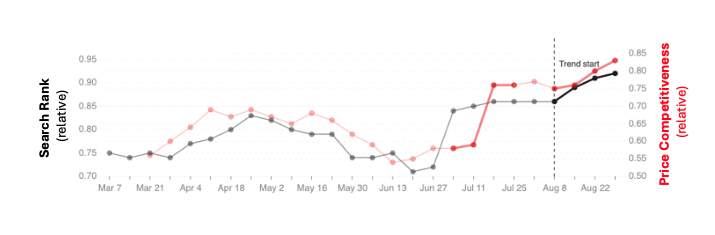
In this example, movements in relative price competitiveness position and relative search rank exhibit a notable relationship, with the strongest pattern appearing at a two-week lag. This should not be interpreted as proof that price caused the subsequent rank movement. Amazon is a complex marketplace with many simultaneous inputs, and an observed relationship alone cannot establish causality. It does, however, provide something more actionable than the observation that rank changed: it identifies a potential driver that deserves further investigation.
Customer experience provides another example of why seemingly separate areas of the business need to be considered together. A review score is not simply a number displayed on a product detail page; it represents experiences previous customers have had with the product and contributes to the information available to the next potential buyer. Importantly, the origins of those experiences can extend well beyond what would normally be considered marketing. Poor preparation can result in damaged products, incorrect labeling can cause the wrong item to reach a customer, and fulfillment or delivery issues can shape the experience surrounding an otherwise good product. ZonPrep makes this connection directly, noting how prep failures can contribute to returns and negative reviews, with subsequent effects on inventory, brand perception and conversion.
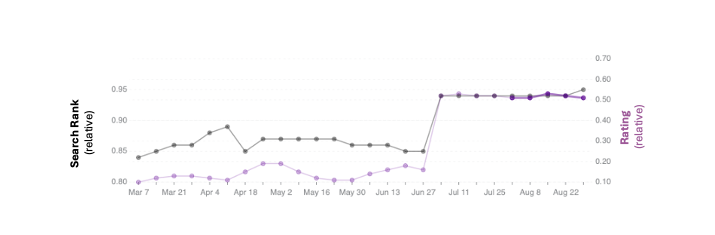
Looking at review performance (rating) alongside search performance allows the seller to examine whether changes in customer reputation coincide with broader marketplace changes. Again, the purpose is not to infer causation from two lines on a chart. It is to recognize that customer experience, conversion potential and marketplace performance belong to the same system and should therefore be analyzed in relation to one another.
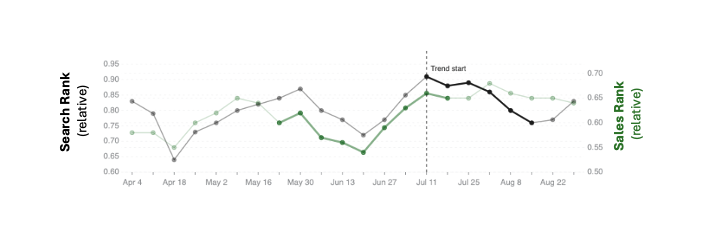
The relationship between sales velocity and search performance illustrates the same principle from another direction. Organizations may have one team monitoring sales and another monitoring organic search position, but commercial momentum and marketplace visibility can be closely related. Examining the two together can reveal periods in which their movements align and help determine whether changes in sales performance are part of the explanation for a change in search position.
Content relevance can be approached in much the same way. Teams often optimize titles, bullets, descriptions and other listing elements, then evaluate whether the resulting content is more complete or contains the desired keywords. Yet a better content score is not itself the business objective. The more meaningful question is whether increased relevance contributes to improved marketplace outcomes for the searches that matter.
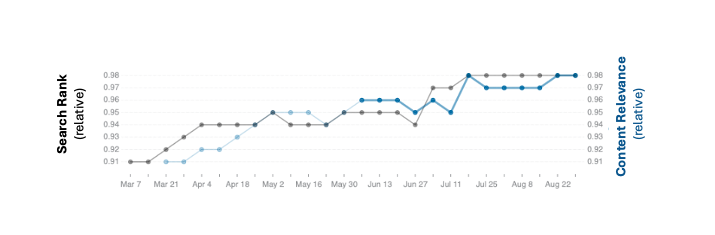
Taken together, these examples suggest a different way of investigating marketplace performance. Rather than asking only whether a particular outcome changed, sellers should examine what else changed around it and which of those movements represent plausible drivers of the outcome.
The Missing Dimension Is Often Time
The relationship between marketplace signals becomes more difficult to understand because effects are not necessarily immediate. A listing change made today may require time before its full impact becomes visible. A pricing change can alter shopper behavior, but the resulting effect on sales velocity and marketplace performance may accumulate over multiple periods. Similarly, an inventory decision made weeks earlier can eventually affect availability or the delivery promise shown to shoppers.
This makes timing an essential part of marketplace analysis. Comparing only metrics from the same day or week can obscure meaningful relationships in which a change in one signal consistently precedes a change in another. In the examples above, DeepM’s analysis identified some of the strongest relationships with a lag rather than simultaneously. This means that evaluating only same-period movements could have obscured a potentially important relationship between the driver and subsequent search performance. The relevant analytical question therefore becomes not merely whether two metrics moved together, but whether movement in one signal consistently preceded movement in another by a plausible period of time.
Timing alone is not enough, however. Two metrics can move in the same direction once simply by coincidence, and even a plausible lag does not establish causation. A stronger signal emerges when a relationship displays persistence and consistency across time. The objective is not to manufacture certainty from imperfect marketplace data, but to distinguish potentially meaningful drivers from the many incidental movements that occur in a dynamic competitive environment.
Logistics Is Part of the Growth Engine
The interconnected nature of Amazon performance becomes particularly apparent when the analysis extends beyond areas traditionally associated with marketplace optimization. Inventory and logistics, for example, are often treated primarily as operational concerns, measured through questions such as how much inventory is available, when replenishment is required, or how much the business is paying for storage and inbound transportation. Those questions are important, but they capture only part of the marketplace impact of logistics.
From the shopper’s perspective, inventory positioning can influence the delivery promise, which can affect the purchase decision, conversion, sales velocity and ultimately marketplace performance. Inventory being somewhere inside Amazon’s network does not necessarily mean every shopper experiences the same offer. As ZonPrep explains, inventory that has been checked in is not necessarily already Prime-eligible, while the location of inventory within Amazon’s network can influence the delivery date presented to customers. Logistics decisions therefore become part of the conversion equation rather than remaining confined to the operations dashboard.
The same principle applies after the purchase. Product preparation and fulfillment influence whether the item reaches the customer correctly and in good condition. Problems at this stage can lead to returns and negative reviews, which can subsequently affect customer trust and the conversion potential of future traffic. ZonPrep’s own analysis connects inadequate preparation with damage, returns, reviews, inventory consequences and brand perception.
This is why logistics should not be viewed simply as something downstream from marketplace optimization. It is one of the inputs into marketplace performance. An issue that ultimately manifests as weaker conversion, sales velocity or search performance may have originated far outside the traditional field of view of the marketing or ecommerce team.
More Data Doesn’t Necessarily Give Better Answers
Large Amazon brands are rarely short of data. They can monitor search rank and Search Query Performance, advertising activity, sales, pricing, listing content, reviews, inventory, competitive activity and operational performance. The challenge is that much of this information is still consumed metric by metric and dashboard by dashboard, making it possible to know a great deal about what is happening without necessarily understanding why it is happening.
Consider a period in which sales decline while advertising efficiency changes, organic rank deteriorates, pricing moves, reviews slip slightly and inventory becomes constrained. Every one of those observations may be accurate, but listing them does not tell the business which development is most important or what it should do next. In fact, adding more dashboards can sometimes make the decision harder by increasing the number of signals that teams must interpret independently.
The more useful objective is to understand how those changes relate to one another, which ones are plausible drivers of the outcome being investigated, and which represent actionable constraints. This marks the transition from monitoring marketplace metrics to extracting marketplace intelligence. Data tells the business what happened; intelligence should help explain what is likely driving the outcome and inform what to do next.
Move From Metrics to Drivers
A driver-based approach does not require every Amazon team to build a sophisticated causal model, but it does require changing the way marketplace data is investigated. The analysis should begin with the outcome the business is trying to understand: perhaps search position deteriorated, sales declined, conversion improved, advertising efficiency changed, or market share was lost. Starting with the outcome prevents the analysis from becoming an indiscriminate review of every metric available.
The next step is to look across potential drivers rather than remaining within the dashboard where the problem first appeared. If search performance declined, for example, the investigation might include content relevance, pricing, advertising activity, reviews, inventory constraints, sales velocity and changes in the competitive environment. The most useful explanation may sit in a completely different dataset or belong operationally to a different team.
Competitive context is equally important. An absolute price of $29.99 says little about competitiveness without knowing what happened to comparable products. The same principle applies to other marketplace signals. Content relevance can improve while competitors improve faster; a rating can remain stable while the competitive benchmark changes; sales can increase while the broader market grows considerably faster. Because Amazon is a marketplace, performance should frequently be understood in relative as well as absolute terms.
Finally, potential relationships need to be evaluated through timing and consistency. Did the suspected driver change before the outcome? Is the delay plausible given the mechanism being examined? Does the relationship recur, or is it based on a single overlapping movement? This deliberately skeptical approach is important because the objective is not to find a story that fits the data, but to identify relationships strong enough to inform a decision.
The analysis should ultimately lead to an actionable constraint. The appropriate response might be a content change, an advertising adjustment, a pricing or promotional decision, improved inventory positioning, or an operational intervention in fulfillment and preparation. This is the approach behind DeepM: connecting marketplace outcomes with their potential drivers, evaluating those relationships in competitive and temporal context, and translating the strongest signals into actionable optimization opportunities. In other cases, the evidence may simply be insufficient to justify a change. That is also a useful conclusion: the purpose of marketplace intelligence is not to generate more activity, but to generate better-informed actions.
Optimize the System, Not the Metric
Amazon businesses will always require specialized expertise. Advertising requires advertising expertise; content, pricing, inventory, logistics and customer experience each involve their own disciplines. The problem arises not from specialization itself, but when analysis and optimization stop at the boundaries between those functions.
Reducing ACOS can be valuable, but reducing ACOS is not the ultimate business objective. Improving content relevance is useful, but a higher content score is not the ultimate objective either. Lowering logistics costs matters, but optimizing solely for operational cost can overlook the effect that inventory positioning and delivery speed have on the customer proposition. Individual metrics are valuable because of what they tell us about the wider marketplace system, not because optimizing each one independently guarantees growth.
The broader objective is therefore to understand which part of the system is currently constraining marketplace performance and which intervention is most likely to improve the outcome. Sometimes the appropriate action takes place inside an advertising campaign; sometimes it requires a listing change or pricing decision; and sometimes the analysis leads from the digital marketplace into inventory, preparation and the physical supply chain.
The actions may belong to different teams, but the performance they collectively create belongs to the same system.
About the Author
Eyal Lanxner is Co-Founder and CTO of DeepM, an AI-based marketplace intelligence and optimization platform for Amazon brands and sellers. Eyal focuses on applying AI and data science to marketplace performance, helping brands connect signals across search, content, advertising, pricing, customer experience, and competitive performance to identify what is driving results and where to optimize next.