How Movatik Grew 35% by Optimizing Their Amazon Inbounds with ZonPrep
Customer: Movatik. Sporting goods, outdoors, and motorsports on Amazon. 5,000+ SKUs.
Model: Miami-based certified reseller, multi-category catalog, wide tail, mixed standard and oversized.
The shift: From cheap freight and 16-day inbound to one or two full truckloads a week and 7-day inbound, with placement fees reduced to a rounding error.
At a glance
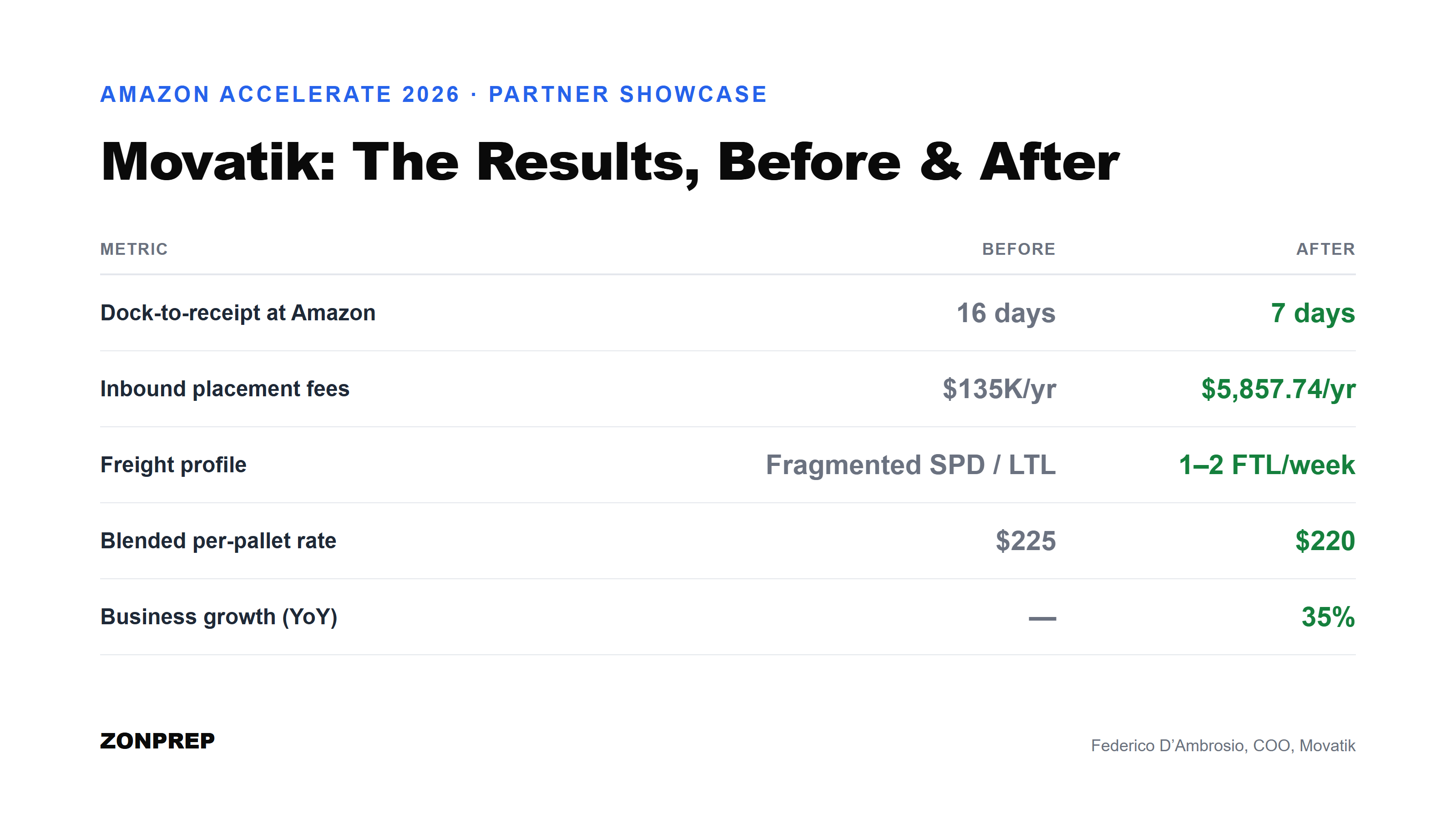
- Dock-to-receipt at Amazon: 16 days down to 7.
- Inbound placement fees: $135,000 a year down to roughly $5,800.
- Freight profile: fragmented small parcel, then LTL, now one to two full truckloads a week.
- Per-pallet rate: $5 savings, on top of all of the efficiencies gained.
- Business growth: 35% year over year, with inventory flow the largest contributor.
Movatik sells sporting goods, outdoors, and motorsports products on Amazon, with more than 5,000 SKUs in their catalog. They're a reseller, which means the catalog behaves unevenly: a consumable SKU might move constantly while a helmet moves slowly, and they can't (or shouldn't) use the same shipping strategy for both.
The seller is based in Miami, which ended up being one of the most important points of this story.
Federico D'Ambrosio (COO) runs the Movatik supply chain. In early 2025, his team was mid-transition from small-parcel shipping to LTL and still working out how the warehouse should run. They were, in his words, looking for a better way to ship. They found it at Amazon Accelerate 2025.
Federico's colleague Peter had come across ZonPrep through a LinkedIn post in an Amazon seller group. Movatik were already registered for the show, so they stopped by the booth to see whether any of it applied to them.
ZonPrep ran their opportunity analysis on the spot, which produced a six-month snapshot of their own shipment data, annualized. We found that their average dock-to-receipt time at Amazon was 16 days, and they were paying more than $130,000 inbound placement fees a year.
"Free freight" that costs a fortune
Although their freight was almost free, it was costing them a fortune. And it's a common, easy-to-fall-into trap that catches many sellers.
There is a national Amazon warehouse in Homestead, thirty minutes from their building. Movatik could fill a full truckload and pay roughly $20 a pallet with Amazon Freight. Against the cost of shipping pallets to Nevada or the West Coast under an optimized split, that looked obvious.
So they took the cheap lane and paid the placement fee instead: roughly 30 cents per unit.
On a rate card, that is a good decision. In the business, it was not.
"What we didn't know is that the problem was going to be time. It was very cheap to send to Amazon, to Homestead, but then the inventory would be stuck in the pipeline between warehouse transfers for up to 30 days before it became available for sale." — Federico D'Ambrosio, Movatik
They ended up with thirty days of inventory that exists, is paid for, and cannot be sold. Movatik's answer at the time was to send more–something that many operators do.
"Our solution at the time was just, we're just going to jam the system with inventory, so we would always have products flowing through. But that became a working capital nightmare, because we had so much cash tied up in inventory that wasn't available for sale." — Federico D'Ambrosio, Movatik
Today, Movatik is at roughly 20 days from vendor invoice to inventory being available for sale. With 60-day vendor terms, the business can start generating cash from that inventory around day 21, before the invoice comes due. The change is bigger than a cheaper pallet: it improves inventory speed and the cash flow of the business.
And then they had a second problem. To skip placement fees, you need five boxes per SKU so a shipment can hit all five regions. Movatik bought inventory as they needed it, which meant that across 5,000 SKUs they frequently did not have the units to split five ways. The optimized path was not available to them even when they wanted it.
For a reseller, slow inventory becomes a disadvantage even more.
"We're a reseller, so sometimes we're not alone on a listing. If you have a competitor that's Prime eligible and you're not, because your inventory is for sale but on a national level, you're never going to compete." — Federico D'Ambrosio, Movatik
The solution: Six steps with ZonPrep
So how did Movatik go from 16 days dock-to-receipt to just a week? Here are six things ZonPrep and Movatik did to optimize their inbounds, get faster receiving times, and reduce placement fees to a rounding error.
1) Consistent replenishment
They stopped placing one large vendor order a month and shipping it small parcel as it trickled in. Now it is pre-season bulk orders plus weekly reorders, so inventory is always flowing even when a forecast misses.
They built a staging area that holds 35 inbound pallets, with up to 30 going out at a time. Through their best months, May through August, that means two trucks a week. In slower weeks, half-size pallets still ship; the fixed rate makes the cost per unit easy to check, so inventory keeps moving.
2) Rate lanes
While freight costs are volatile, spot quoting 24 to 36 hours ahead beats a locked-in rate. Booking is now an email: someone on Federico's team writes that a pallet is nearly finished and asks for a truck tomorrow morning or tomorrow afternoon. The truck is there. No carrier chasing, no negotiating.
3) Consolidation
Every Movatik FBA shipment now goes out as a floor-loaded full truckload with a live unload appointment, booked 21 days ahead. That predictable speed lets the team reorder faster and recover from a bad forecast because inventory is available again in about 20 days. It supports on-time payments, keeps cash moving, and has helped underpin Movatik's 35% growth.
4) Timing
Product arrives throughout the week, and Movatik aims to clear the warehouse by Friday and send a truck to ZonPrep. That puts its freight first in the queue on Monday morning, ready to move on to Amazon. The team is still refining the rhythm, but the principle is clear: when freight reaches the partner determines which week's Amazon movement it catches.
5) The split shipment strategy
This is the strategy that required changing the business, not just the shipping. Movatik put a floor on purchasing five units per SKU, every buy.
Where five units meant two months of inventory, fine. Where it meant four months, they cut the SKU. They stagger standard and oversized so each truck is one or the other, because mixing them defeats the optimization.
And Amazon's pack later option means they could pick where everything is going first, then pack, instead of trying to build five identical boxes upfront.
"The goal isn't to optimize every single unit. The goal is to optimize the core of the business." — Federico D'Ambrosio, Movatik
So the 20% of SKUs driving 80% of revenue are shipped fully optimized. Back-order onesies and shelf-clearing twosies ride an occasional consolidated pallet.
6) Proof of delivery
Before ZonPrep, retrieving proof of delivery depended on the carrier and could turn into a real process. In some cases, Movatik's only proof of shipment was a physical copy of the bill of lading stored in the warehouse.
That matters when Amazon records fewer units than Movatik shipped. If 1,500 units leave the warehouse and Amazon receives only 1,000, the signed POD provides the documentation needed to pursue the missing inventory.
Today, the POD is already available in the ZonPrep portal when Amazon asks for it. Movatik's team can pull the POD, submit it with the invoice, and move on instead of searching inboxes or chasing carriers. Amazon's signature creates a clear record that the shipment was received, making the claims process much simpler.
The results
One year in, ZonPrep and Movatik stepped on stage at Amazon Accelerate 2026 to share their results.
"We're growing about 35% this year, and that improved inventory flow has been a big part of supporting that growth. We haven't done a lot of other wow moments in the operation besides this." — Federico D'Ambrosio, Movatik
- Dock-to-receipt: 16 days to 7. With an extra stop in the route, not despite one. Floor-loaded trucks hit appointments booked three weeks out.
- Placement fees: $135,000 a year to about $5,800. Not eliminated. Turned into a rounding error, paid only on the narrow tail of the catalog that will never have the volume to split.
- Freight: one to two full truckloads a week, instead of fragmented small parcel and LTL.
- Invoice to sellable: roughly 20 days, against 60-day vendor terms. Movatik now sell the inventory before the invoice comes due.
- Per-pallet rate: $225 to $220, on top of all of the efficiencies and speed gained.
"If you only look at the rate card, saving five dollars per pallet might look important. But that number doesn't show you the shipping speed, how quickly inventory becomes available for sale, shipment accuracy, or the impact on working capital. Those benefits are worth a lot more than five dollars a pallet." — Federico D'Ambrosio, Movatik
Even though their per-pallet rate only dropped 2%, everything else meant their business grew about 35%.
Speed compounds in a direction most rate cards never show. Inventory sells through faster, so Movatik reorder faster, so capital goes back to work faster. They pay vendors on time, their credit line keeps growing, and they reinvest it in more inventory.
Why it works for a wide-catalog reseller
A lot of the scale story in this industry gets told through brand owners sending truckloads of three ASINs. Movatik is the harder case: 5,000+ SKUs, uneven velocity, standard and oversized mixed, and a tail that will never justify a five-way split.
The reason it works is that Movatik are not the ones running five optimized trucks.
"We fill one truck, not five. If I had to fill five optimized trucks myself, that's a hundred and fifty pallets sitting on my floor. We don't have the space. We play Tetris in that warehouse as it is." — Federico D'Ambrosio, Movatik
Thirty pallets, sometimes 60, go out every week and ship to one place. ZonPrep takes care of the splits down the line.
Wrapping up: Prioritizing inbound efficiency over cost, then getting both
Movatik were not badly run before ZonPrep. They were just optimizing the number in front of them. Freight into Homestead was genuinely cheap, and the placement fee was a line item they could see and budget for.
Then they started looking at the numbers that weren't on the rate card–30 days of capital sitting still, the Prime eligibility they were losing to competitors on shared listings, and the replenishment rhythm they could not hold.
They actioned six strategic steps with ZonPrep, their per-pallet rate reduced five dollars, and cut their inbound lead times in half.
"Growth doesn't come from trying to do everything yourself. For us, a major unlock was recognizing where the right partner could do something better than we could. On the inbound side, we chose a partner that complemented our operation, helped us move faster, improved our cash flow, and supported our growth. Don't optimize your business just to save a few dollars. Optimize it to create value." — Federico D'Ambrosio, Movatik
Want to know what your true blended per-pallet rate actually is? Request your Amazon FBA opportunity analysis, the same one Movatik got at the booth.