Amazon AWD Fees Are Going Up in 2027: What Changes and How to Plan for It
Processing, transportation and storage all change for Amazon Warehousing and Distribution in 2027. Here are the numbers, the per-box math, and how to decide which inventory belongs in AWD.
On November 5, Amazon published its 2027 US fee changes. Most of the coverage went to the headline: FBA fulfillment fees rise by an average of $0.19 per unit on January 15.
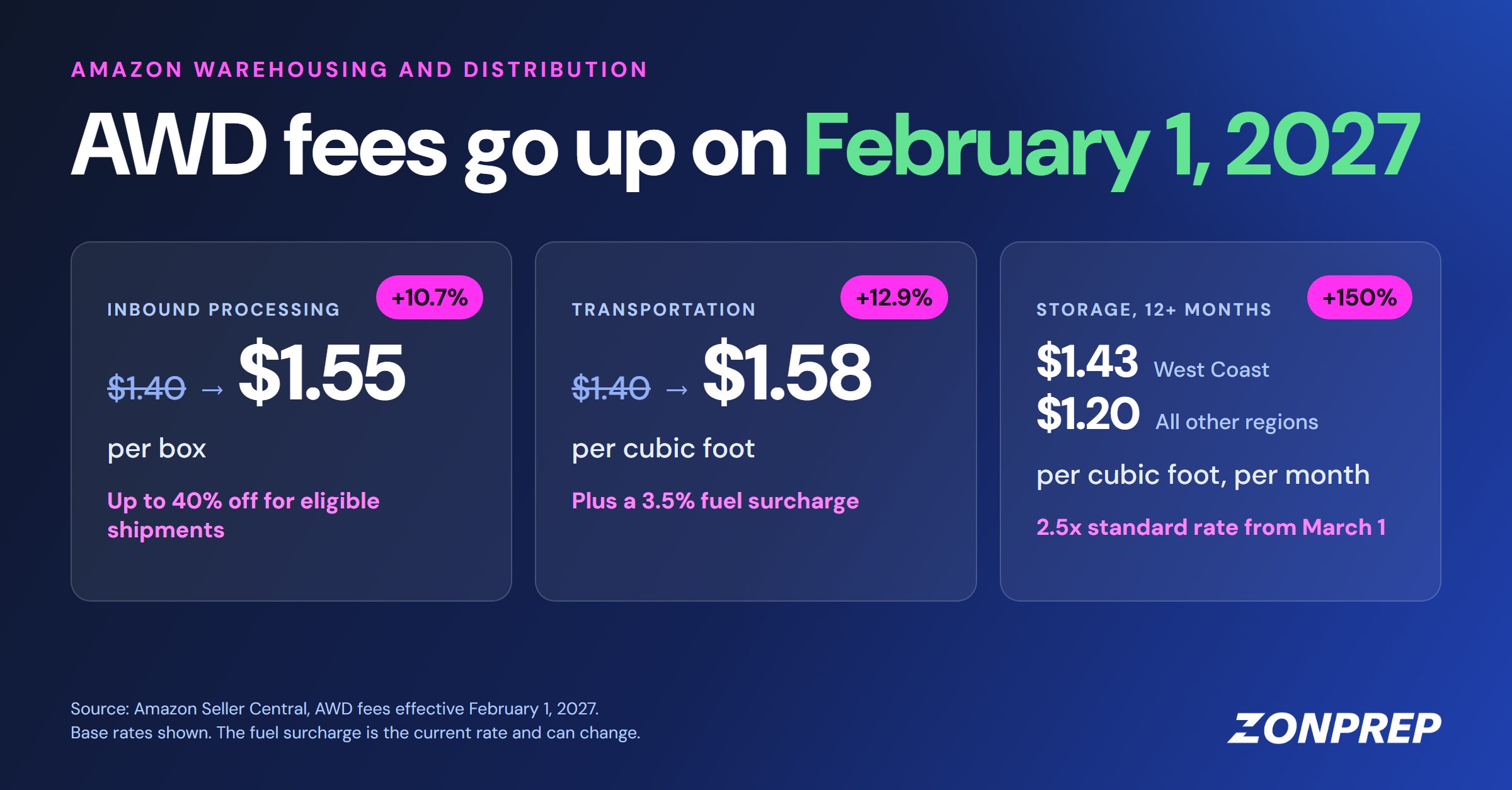
The Amazon Warehousing and Distribution (AWD) changes got far less attention, and for brands that run bulk inventory through AWD they are the bigger line item. Processing goes from $1.40 to $1.55 per box, inbound and outbound. Transportation goes from $1.40 to $1.58 per cubic foot, and a fuel and logistics surcharge now applies on top of it. Storage becomes age-based, with inventory held longer than 12 months billed at 2.5 times the standard rate.
Two details in the rate table are easy to miss. The Amazon managed discount on transportation goes away, and the deepest inbound discount, 40% off for single-ASIN pallets, applies in the West Coast Palletizable region.
This post covers the numbers, the per-box math, what AWD still gives you, and how to decide which inventory should go through AWD and which should flow directly into FBA.
What changes for AWD in 2027
Here are the 2027 rates next to the rates in effect until January 31, 2027. Both come from Amazon’s AWD fees page in Seller Central. Rates are base rates unless noted.
| AWD fee | Until January 31, 2027 | 2027 rate | Change | Effective |
|---|---|---|---|---|
| Inbound processing | $1.40 per box | $1.55 per box | +10.7% | February 1, 2027 |
| Outbound processing | $1.40 per box | $1.55 per box | +10.7% | February 1, 2027 |
| Transportation, base and smart storage rates | $1.40 per cubic foot | $1.58 per cubic foot | +12.9% | February 1, 2027 |
| Transportation, Amazon managed rate | $1.26 per cubic foot | $1.58 per cubic foot | +25.4% | February 1, 2027 |
| Fuel and logistics surcharge on transportation | None | 3.5% (current rate) | New | February 1, 2027 |
| Transportation including the surcharge, base rate | $1.40 per cubic foot | About $1.64 per cubic foot | +16.8% | February 1, 2027 |
| Inbound processing, West Coast Palletizable region | $1.05 per box | $1.16 per box (carton template) or $0.93 per box (single-ASIN pallets) | +10.5% or -11.4% | February 1, 2027 |
| Storage, inventory under 12 months | $0.57 West Coast, $0.48 other regions, per cubic foot per month | Unchanged | None | |
| Storage, inventory over 12 months | $0.57 West Coast, $0.48 other regions | $1.43 West Coast, $1.20 other regions | 2.5x | March 1, 2027 |
Three notes on reading that table.
The surcharge moves. 3.5% is the current rate, the same as the surcharge on FBA fulfillment fees. Amazon says it will keep reviewing it as conditions change, so treat the transportation line as a floating number in your 2027 model.
Amazon managed transportation loses its discount. Until January 31, the Amazon managed transportation rate is $1.26 per cubic foot, 10% under base. The 2027 rate table lists $1.58 for all three rate types. For SKUs on the Amazon managed rate, that is a 25.4% increase before the surcharge and 29.8% after it. The storage discounts stay: 10% for smart storage and 20% for Amazon managed, with no change to the qualification criteria.
The 40% discount is regional. Amazon’s 2027 fee summary describes a 40% inbound processing discount for single-SKU pallets. The rate table places it in the West Coast Palletizable region, as a promotional discount for shipments sent in as single-ASIN pallets with no loose boxes: $0.93 per box. Shipments on the carton template in that region, with enough boxes to build single-ASIN pallets, pay $1.16. Everywhere else, inbound processing is $1.55. The current $1.05 rate in that region runs until January 31, 2027, per Amazon’s AWD West Coast Palletizable page.
The per-box math
The per-box and per-cubic-foot increases look small. They add up differently depending on the size of your cartons, because the larger of the two increases is charged on cube.
Take a master carton that measures 18 x 14 x 12 inches. That is 1.75 cubic feet. Here is inbound processing plus transportation for that box. These are illustrative numbers, so you can run the same math on your own cartons.
| 2026 base | 2027 base | 2027 West Coast Palletizable, single-ASIN pallets | |
|---|---|---|---|
| Inbound processing | $1.40 | $1.55 | $0.93 |
| Transportation (1.75 cubic feet) | $2.45 | $2.77 | $2.77 |
| Fuel and logistics surcharge (3.5%) | $0.00 | $0.10 | $0.10 |
| Total per box | $3.85 | $4.41 | $3.79 |
At base rates that is 56 cents more per box, a 14.6% increase. At 10,000 boxes a month, it comes to about $5,600 a month, or roughly $67,000 a year on inbound processing and transportation alone.
Outbound processing rises too, so a complete number includes it. The annual model assumes 120,000 cartons are received and subsequently shipped out, with one outbound processing charge per carton. Not every carton necessarily has the same handling pattern, so adjust the assumption to yours.
| Illustrative annual impact at 10,000 cartons a month | 2026 | 2027 |
|---|---|---|
| Inbound processing, transportation and outbound processing | $630,000 | $715,413 |
| Annual increase, before storage | +$85,413 (+13.6%) |
At the same carton volume, qualifying West Coast single-ASIN pallet shipments would have a materially different cost profile, illustrating why shipment configuration now matters more.
Three things stand out.
Nearly three quarters of the inbound increase comes from transportation. Of the 56 cents, 41 cents is the higher cubic-foot rate plus the surcharge. The bigger and lighter your cartons, the more this change costs you. A 3 cubic foot carton goes from $5.60 to $6.46 on the same two lines, a 15.3% increase.
Amazon managed SKUs see the largest jump. The same 1.75 cubic foot box costs about $3.61 today on the Amazon managed transportation rate. In 2027 it costs $4.41, the same as base. That is an increase of about 22%.
The pallet discount softens the increase in one region. It doesn’t cancel it. The $3.79 in the third column looks like a saving against $3.85, but shipments that qualify in the West Coast Palletizable region already pay $1.05 for inbound processing, so that box costs $3.50 today. It goes to $3.79 as single-ASIN pallets, up 8.3%, and to $4.02 on the carton template, up 14.9%.
Age-based storage starts March 1
The storage change arrives a month after the others. From March 1, 2027, AWD storage has two tiers based on how long inventory has been there.
- Standard tier, under 12 months: the existing rate. At base that is $0.57 per cubic foot per month on the West Coast and $0.48 in the East Coast, South East and South Central regions.
- Aged inventory tier, over 12 months (365 days): 2.5 times the standard rate. At base that is $1.43 on the West Coast and $1.20 in the other regions.
The smart storage and Amazon managed discounts apply on top of the aged rate. Smart storage brings it to $1.28 on the West Coast and $1.08 elsewhere. Amazon managed brings it to $1.14 and $0.96.
Amazon says the AWD Inventory dashboard will show inventory age in days next to each FNSKU, with an estimated storage cost for inventory over 12 months. Amazon is also introducing storage reservations and removal and disposal options for AWD inventory, each with its own fees.
AWD has been priced as the place to hold inventory you don’t need at a fulfillment center yet. That still holds for inventory that turns. For inventory that doesn’t, the cost of leaving it there more than doubles once it passes a year.
What the new pricing rewards
Read the AWD changes next to the FBA storage changes Amazon announced the same day and they point in one direction.
On the FBA side, Amazon is removing the storage utilization surcharge on February 1, and folding the aged inventory surcharge into the monthly storage fee as a single age-based rate. Amazon says this means flat or lower fees for inventory that turns in under six months and higher fees for aged inventory.
On the AWD side, the deepest inbound discount goes to single-ASIN pallets with no loose boxes, which are the easiest inbound freight to receive. The storage discounts stay with SKUs that replenish automatically into FBA. The 2.5x rate goes to inventory that has been sitting for more than a year. Amazon’s own stated reason for the aged tier is “to encourage optimal capacity utilization.”
This is our read of the pricing, not something Amazon has stated: the 2027 changes increasingly reward efficient pallet configurations and faster-moving inventory, while making inefficient freight and aged inventory more expensive. The discounts make certain configurations relatively more economical, but they do not necessarily make them cheaper than 2026. That is a reasonable way to price a network, and it matches how the best operators already run. It does mean a storage-heavy inbound plan gets more expensive next year at both layers.
What AWD still gives you
Higher fees are only half of the calculation. AWD offers meaningful benefits beyond inexpensive storage, and they remain relevant under the 2027 changes.
| AWD advantage | What it means for operators |
|---|---|
| FBA placement fee avoidance | Qualifying AWD-to-FBA replenishment avoids separate inbound placement fees |
| Low-inventory-level fee exemption | SKUs with at least 70% AWD auto-replenishment over the preceding 90 days, without a maximum replenishment limit, can qualify for exemption from the FBA low-inventory-level fee. |
| FBA age-based storage benefit | Qualifying AWD auto-replenished inventory receives the lowest FBA unified storage age tier regardless of age |
| FBA capacity flexibility | AWD auto-replenishment to FBA isn’t subject to the usual FBA capacity limits |
One important nuance: Amazon’s Smart Storage and Amazon Managed discounts also require at least 70 days of combined historical supply across AWD and FBA, along with the qualifying auto-replenishment ratio. That is another reason not to oversimplify the days-on-hand discussion.
So the useful question isn’t whether AWD fees are increasing. It is this: at what point does the additional cost of AWD outweigh its placement, replenishment, capacity, and fee benefits?
Who is most exposed
Based on the rate structure, four profiles take the largest share of the increase.
- Eligible products with high cubic volume relative to their selling price. Transportation is charged per cubic foot, and it carries the larger increase plus the surcharge. Catalogs with a lot of air in the carton absorb more of it per dollar of inventory. Since July 31, 2026, AWD only accepts sortable items: smaller than 18 x 14 x 8 inches and under 20 pounds.
- SKUs on the Amazon managed transportation rate. $1.26 to $1.58 per cubic foot is the largest percentage increase on the rate card.
- Slow movers and seasonal carryover. Anything that passes 12 months in AWD after March 1 moves to the aged inventory tier.
- Brands using AWD as a buffer against slow inbound. If you hold extra inventory upstream because replenishment into FBA is unpredictable, you are paying the new rates on units you would not otherwise carry.
The last one is the profile we see most often, and it is the one a rate table can’t fix. Across the brands we work with, one recurring issue is that inventory buffers are often sized around inconsistent inbound lead times rather than actual demand variability. We made the longer case in Storage Is Not an FBA Strategy: the number of units exposed to a storage fee schedule is set by how much buffer your inbound forces you to carry.
What to do before February 1
You have about eleven weeks. Here is the order we would work in.
- Re-run your AWD cost per box with your real cube. Use your actual carton dimensions and the rate type each SKU is on. Add the 3.5% surcharge to transportation, and include outbound processing. Amazon says its Revenue Calculator has been updated to reflect the surcharge.
- Check which rate tier each SKU is on. Smart storage requires at least 70% of a SKU’s inventory to move through AWD automatic replenishment over the preceding 90 days, plus 70 days of combined historical supply across AWD and FBA. The tier sets your storage rate, including the aged rate.
- If you ship into the West Coast Palletizable region, check your pallet builds. Single-ASIN pallets with no loose boxes pay $0.93 per box for inbound processing. The carton template pays $1.16. Amazon’s AWD West Coast Palletizable page has the eligibility rules.
- Tighten your pack-out. Every cubic foot you take out of a carton saves about $1.64 in AWD transportation in 2027. Carton-size decisions that were marginal in 2026 are worth revisiting.
- Run an age report before March 1. Identify AWD inventory that will cross 365 days in the first half of 2027. Decide now whether to replenish it into FBA, promote it, or create a removal order.
- Split your catalog by job. Decide SKU by SKU which products need an upstream buffer and which should flow straight into FBA. The framework in the next section is a place to start.
Which inventory should go where
These are frameworks to test, not universal rules.
| Inventory profile | Strategy worth evaluating | Primary consideration |
|---|---|---|
| High-velocity, predictable demand | Direct optimized FBA | Can faster replenishment reduce buffer inventory and total landed cost? |
| High-velocity but unpredictable demand | AWD or hybrid | Is automatic replenishment worth the added handling and transportation? |
| Slow-moving inventory | External 3PL or limited AWD | Which option minimizes long-term carrying and removal costs? |
| Seasonal inventory with large peak requirements | AWD, 3PL, or hybrid | Capacity, peak demand timing, placement costs, and sell-through risk |
| Existing Amazon Managed SKUs | Re-model AWD economics | Loss of transportation discount could materially alter costs |
When you compare AWD against flowing inventory direct, compare complete costs. AWD pricing covers FBA inbound placement, so there is no separate placement charge for inventory that replenishes through it.
The right comparison is total cost per sellable unit, from the initial warehouse through Amazon receiving. Include transportation, processing, placement, storage, applicable fee exemptions, replenishment time, and the working capital tied up in inventory.
A complete model should include:
- Freight to the initial warehouse
- Both AWD processing charges
- AWD-to-FBA transportation
- Storage duration
- Applicable fee exemptions
- Direct FBA shipment processing costs
- FBA storage
- Inbound timing
- The risk or cost of unavailable inventory
Compare results on a common basis, such as cost per sellable unit or cost per pallet equivalent, rather than relying solely on carton and pallet rates.
One SKU, two paths
Here is how that comparison looks for a single SKU. The numbers are illustrative. Swap in your own.
The SKU sells 500 units a day. It ships 24 units to a carton, each carton is 1.75 cubic feet, and landed cost is $8 per unit.
Through AWD, at 2027 base rates:
- Inbound processing, transportation with the surcharge, and outbound processing come to $5.96 per carton. That is about 25 cents per unit, or roughly $45,300 a year on this SKU.
- Storage adds about $175 a month for every 10 days of cover held in AWD, at the $0.48 base rate.
- In return, replenishment into FBA carries no separate placement fee. If at least 70% of the SKU’s inventory moves through AWD automatic replenishment over the previous 90 days, with no maximum limit set on replenishment, it can also qualify for the low-inventory-level fee exemption and the lowest FBA storage age tier.
- The smart storage and Amazon managed storage discounts are a separate test: 70 days of combined historical supply. On this SKU the 10% smart storage discount is worth less than $20 a month for every 10 days of cover in AWD, so it is not a reason to hold more inventory.
Direct into FBA:
- There are no AWD processing, transportation or storage charges. You pay your own freight and prep, and either Amazon’s inbound placement fee or the freight to send optimized splits.
- Days on hand depend on your replenishment. Every 10 days of cover on this SKU is 5,000 units, or $40,000 of working capital.
Here is the comparison laid out per unit. The AWD column uses Amazon’s 2027 base rates for this SKU. The remaining cells depend on your own freight, prep and placement numbers, so they are left for you to fill in.
| Cost component | AWD | Direct FBA |
|---|---|---|
| Inbound freight | Your freight to AWD | Your freight to your prep or cross-dock facility |
| Processing/prep | $0.13 (inbound and outbound processing) | Your prep cost |
| Transportation | $0.12 (AWD to FBA, with the surcharge) | Included in freight |
| FBA placement | $0 qualifying AWD flow | Amazon’s inbound placement fee, or $0 with optimized splits |
| Storage | About 3.5 cents per unit for each month in AWD, plus FBA storage | FBA storage |
| Inventory carrying cost | $8 x your cost of capital x days of cover / 365 | $8 x your cost of capital x days of cover / 365 |
| Total cost per unit | $0.25 plus freight, storage and carrying cost | Your total |
Put the two on the same basis. AWD costs this SKU about 25 cents a unit in handling and transportation, plus storage for the days it sits there. The direct path costs your freight into Amazon, your prep, and the placement fee if you pay one. AWD transportation replaces freight you would pay anyway, so compare the totals, not the 25 cents alone.
Then compare inventory. Whichever path lets you hold fewer days of cover without stocking out frees $40,000 for every 10 days on this SKU. The low-inventory-level exemption is most valuable for SKUs that would otherwise fall below Amazon’s 28-day historical supply threshold. A SKU carrying 45 days of current cover may not incur the fee, but eligibility depends on Amazon’s historical supply calculation, not just today’s inventory position.
How much upstream inventory do you need?
A fee change like this one is a good prompt to ask why inventory is sitting upstream at all.
The amount of buffer a brand needs depends on how long it takes the next shipment to arrive and be received, and how predictable that time is. Shorten the lead time and the buffer shrinks. That is true whether the buffer sits in AWD, at a 3PL, or in your own warehouse.
For brands with predictable demand and reliable replenishment, 30 to 60 days of FBA inventory may be achievable. The right number depends on each SKU’s velocity, replenishment variability, and Amazon’s inventory-level fees. From February 1, 2027, Amazon’s low-inventory-level fee applies only when inventory falls below 28 days of supply, based on actual shipments in both the four weeks before and after the assessment date. A 30-day target can still leave very little margin for demand spikes or receiving delays.
A faster, more predictable replenishment process can allow brands to reduce FBA days on hand. The right target varies by SKU, but reducing unnecessary buffer without increasing stockout risk should be the objective.
That is the problem ZonPrep is built around. ZonPrep is built for throughput, not long-term storage. Our model prioritizes moving inventory into Amazon quickly, with limited short-term buffer storage when needed. Clients ship to one place, our facilities in McDonough, Georgia, and our Cross-Dock team consolidates that freight into floor-loaded truckloads to Amazon as optimized splits.
- 24 to 48 hours is our average inbound check-in at Amazon, measured from when shipments leave our facility.
- If clients are also using ZonPrep for prep, they get a 72-hour maximum prep SLA from our dock.
- We quote 5 days or less, year round, from arrival at our facility to arrival at Amazon. That includes Prime Day, Black Friday and Cyber Monday. The five-day commitment covers transportation to Amazon. It does not guarantee that Amazon will make the inventory sellable within five days.
Check-in at Amazon is not the same as inventory becoming sellable or Prime eligible. Amazon controls how fast inventory moves inside its network once it is checked in.
We ship more than 20 million units into Amazon every month for 200+ brands, and the pattern is consistent: when lead time comes down, the buffer comes down with it. Front Row took days on hand from 90 to the low 70s after moving its middle mile to us, with shorter lead times doing the work.
AWD and a fast direct inbound are not mutually exclusive, and plenty of brands will keep using both. We compared the two models in Amazon AWD vs Cross Dock. What the 2027 rates change is the cost of every unit you park upstream, which makes it worth knowing how many of those units are there by choice.
The takeaway
The 2027 AWD changes are specific enough to plan around. Processing rises 10.7%, inbound and outbound. Transportation rises 12.9% before a 3.5% surcharge and 16.8% after it, and the Amazon managed transportation discount goes away. From March 1, inventory older than 12 months pays $1.43 per cubic foot per month on the West Coast and $1.20 in the other regions, against $0.57 and $0.48 for everything younger.
Knowing what Amazon is changing is the first step. The decision is what to change in your own business: which inventory should go through AWD, which should flow directly into FBA, and what determines the right choice for each SKU. Model both paths on a cost per sellable unit basis before February 1.
Re-run your cost per box, check your rate tiers, clear your aging inventory, and decide which SKUs need to sit upstream at all.
If you want to see what your inbound would look like with a shorter lead time, request a complimentary FBA Opportunity Analysis or read more about our Cross-Dock service.
Let’s get after it.
Related reading: